Showing posts with label Ancient Greece. Show all posts

Wednesday, 25 September 2019

Corinth rebuilt by the Romans


The Greek city of Corinth, on the northern shore of the Peloponnese peninsula, west of Athens, was an important trading centre long before the Romans arrived. When they did, in 146 BC, they destroyed the city and left it as a deserted shell.

The revival of Corinth came about as a result of Julius Caesar’s policy of settling retired and discharged legionary veterans in colonies distributed throughout the Empire. The first colonists arrived after Caesar’s assassination in 44 BC and they set about constructing a city very much on Roman lines.

Some Greek elements were retained in the new city, such as the Agora (forum), several stoas (covered walkways) and the Temple of Apollo, but the impression conveyed by what can be seen today is that this was a Roman city that would in time become suitable as the capital of a province, in this case Archaea.

Roman Corinth was very much a commercial centre, with a number of the buildings relating to mercantile activities.

Commerce clearly brought wealth to Corinth, as evidenced by the buildings devoted to leisure and entertainment. The original Greek theatre was converted to accommodate Roman pleasures, such as gladiatorial contests. There was also an odeum – a small theatre designed for musical performances.

Corinth was a religious city, with six temples built to revere the Roman gods during the second century AD. We know that Corinth had a small but active Christian community, from the fact that St Paul wrote two of his best-known epistles to the Corinthian Christians during the mid-first century. Paul is known to have stayed at Corinth for 18 months, during which he worked as a tentmaker and preached.

However, during the third century the fortunes of Corinth went into decline as commercial activity decreased. The Roman city was itself abandoned, with the centre of modern Corinth lying a few miles to the northeast. This has made it possible for extensive archaeological work to be done on the Roman remains, with the result that much has been learned about how a typical colonial capital operated.

A notable feature a few miles away from the Roman city is the Corinth Canal, cut through the narrowest point of the isthmus (four miles wide) to provide easier access to the port of Piraeus. Several projects to build a canal were proposed in classical times but abandoned for various reasons, including the difficulty of cutting down through up to 250 feet of solid limestone.

One attempt was made by the Emperor Nero in 67 AD, when on a visit to the region. He instructed the Praetorian Guard to begin work immediately and joined in by shovelling up a bucketful of dirt and carrying it away on his back. However, he soon lost interest in the idea, which was not revived until long after his assassination in 69 AD. The current canal, which follows the same course that Nero had in mind, was begun in 1881 and completed in 1893.
© John Welford

Tuesday, 18 September 2018

The Battle of Marathon, 490 BC


The Battle of Marathon took place in August or September 490 BC, the combatants being the city-state of Athens and the Persian Empire under King Darius. The details are quite well known thanks to the Greek historian Herodotus, although the battle happened several years before he was born. That said, the reason why the battle is best known to history is one of the less trustworthy parts of the account.
Darius was determined to bring the city-states of Greece under his control, having already conquered Turkey and Macedonia, and to that end he landed an army of 20,000 men on the shore of the Bay of Marathon, 25 miles from Athens. The Athenians sent a force of 10,000 “hoplites” to meet them. These were infantry troops, armed with a large shield and a long stabbing spear. 
With the armies in full view of each other, nothing happened for five days as each side waited for the other to make the first move. Eventually it was the Greeks who attacked, advancing at a run and being met by a hail of arrows. 
The Persians were astounded that the Greeks could hope to win given that they had no cavalry nor archers, and at first it looked as though they would be proved right. However, when the battle turned to hand-to-hand fighting it was the Greeks who triumphed.
The Persian ranks broke and they fled back to the safety of their ships, having lost about 6,000 casualties. By contrast, the Greek losses – according to Herodotus – were around 200.
And did Pheidippides run all the way to Athens with news of the victory, dying after his mission was accomplished and bequeathing the “Marathon” to the world of athletics? Well, not according to Herodotus, who described Pheidippides as taking the news to Sparta, which he reached two days later before returning to Athens and not expiring when he did so. It was the much later writer Lucian who gave voice to the generally believed myth.
© John Welford

Tuesday, 28 August 2018

The Temple of Apollo Epicurius, Bassae, Greece


Although it was built during the 5th century BC, the Temple of Apollo Epicurius near Bassae in western Greece was virtually unknown until 1765 when a French architect happened upon it when he was in the area building villas – he had the misfortune to be murdered by bandits when he went back for a second look. 

The temple has features in common with those of the much more famous Parthenon at Athens, and they may even have been designed by the same architect. However, the Temple of Apollo Epicurius is much smaller, measuring around 38 by 14.5 metres, and it is in a remote location high up a mountain slope, which is why it was virtually lost for many centuries, with only a handful of references being made to it by ancient writers. 

The temple’s dedication to Apollo Epicurius – “Apollo the Healer” – was due to the gratitude of local people who escaped the worst ravages of a plague after praying and sacrificing to the god. 

The temple is notable for several features, not least the fact that it includes features of all three classical orders of architecture – Ionic, Doric and Corinthian. The outer columns (the peristyle) are Doric, the inner ones are Ionic, and there is a single Corinthian column at the centre. The capital of the Corinthian column (typified by the use of decorative stone acanthus leaves) is the earliest example of the order known to exist. 

Another unusual feature is the combined use of limestone and marble in the construction. 

The temple was originally decorated with 23 sculptured plates on the frieze of the Ionic interior, but these were removed in 1812 by British antiquaries. These plates soon found their way to the British Museum in London, where they remain to this day, not far from where the much better-known Parthenon frieze is housed (the “Elgin Marbles”). The frieze depicted battles between Greeks and Centaurs and between Greeks and Amazons. 

There has been considerable argument about whether the Parthenon frieze should be returned to Greece, but maybe the Bassae frieze has a better claim to be taken back to its original home? For one thing, it might be possible to return the plates to their exact original position, which is out of the question in the case of the Parthenon frieze due in part to the destructive influence of pollution in Greece’s capital city. 

On the other hand, the remote location of the Temple of Apollo Epicurius, which is well off the normal tourist trail, means that far fewer people would be able to see the frieze were it to be returned than is now possible in the British Museum. 

The Temple of Apollo Epicurius was declared a UNESCO World Heritage site in 1986.


© John Welford


Tuesday, 20 March 2018

Leonidas, King of Sparta


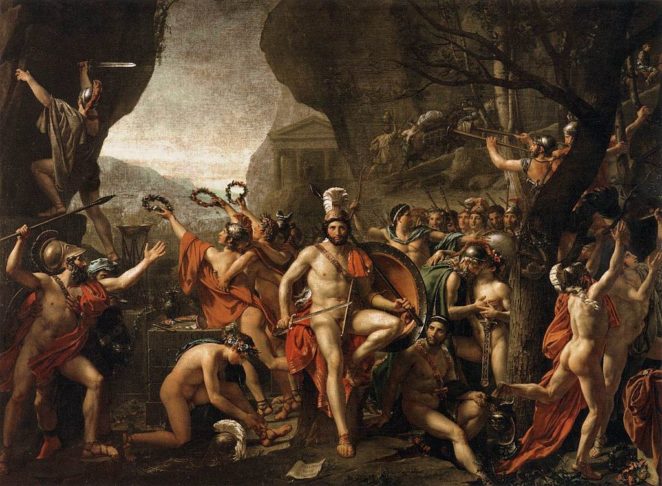
Leonidas was a hero of ancient Greece whose conduct at the Battle of Thermopylae has become a byword down the centuries for selfless heroism against overwhelming odds.

Born in around 521 BC, Leonidas (the name means “lion-like”) was one of the sons of King Anaxandridas of Sparta. He became king himself in 491 BC, succeeding his half-brother Cleomenes.

The invasion of Greece by the Persians under Xerxes, in 480 BC, led to Leonidas’s determination to make a stand against the enemy. He chose 300 Spartan warriors who themselves had sons, so as not to risk the extinction of their families. On his march he was joined by troops from other cities, so his total force was around 7000 before he reached the pass of Thermopylae in August or September (accounts differ).

Thermopylae (the “hot gates”) was of huge strategic importance because it consisted of a very narrow route between a mountain and a morass, and was the only way of gaining access to southern Greece from the north, which the Persian force of at least 100,000 men was seeking to do.

As told by the historian Herodotus some fifty years after the event, Leonidas’s army was able to hold the Persians at bay for two days, inflicting massive casualties on them. However, a traitor named Ephialtes told the Persians about a mountain path that enabled them to skirt round the Greek army and then attack them from the rear.

On hearing of this move, Leonidas realised the hopelessness of his position. He dismissed all the troops except his own Spartans (men from Thespis and Thebes also volunteered to remain) and made a frontal attack on the Persians who confronted him, with the sole aim of selling Greek lives as dearly as possible. In the desperate battle that ensued, Leonidas was an early faller. His body was rescued by the Greeks, and the place where he fell was later marked by a stone lion.

Despite the defeat, the Greeks were emboldened by the courage and self-sacrifice of Leonidas and his men, and redoubled their efforts to repel the invading Persians, which was achieved after the naval victory at Salamis the following month.

Leonidas’s story has inspired military campaigners down the centuries, as well the 2007 movie “300” directed by Zack Snyder, which was itself based an earlier comic-book mini-series.

Alexander the Great was to find himself in the opposite situation to Leonidas during his own invasion of Persia in 330 BC. Unable to force through the narrow pass of the Persian Gate, Alexander sought, and found, a local guide to show him a mountain path by which he could take his men to a position from which he could attack the defenders from behind. 

© John Welford

Monday, 19 June 2017

Neolithic Greece


The Neolithic (New Stone Age) era in ancient Greece must be reckoned to date from around 6800 BCE to 3200 BCE. Climatic changes made it possible for groups of people to settle in fixed locations and for the hunter-gatherer economy of the Palaeolithic and Mesolithic eras to give way to more settled ways of life, including farming, stock-rearing, and the creation of pottery. Around 1,000 sites have been identified that show signs of occupation in the Neolithic period.

Communities grew up where there was an adequate water supply and suitable conditions for growing food. This included settlements where mud huts were built in groups, in both coastal locations and further inland, and places where caves were used as shelters. The plains of Thessaly and Macedonia were the mostly densely populated areas, and the more mountainous districts less so.

The archaeological evidence shows that some communities were more advanced than others, such that some had houses built at least partly of stone, or bricks made from dried mud. They were mainly single-room dwellings, but some may have been two-storey. Villages were often surrounded by a ditch or a stone wall.

In the early Neolithic, communities probably consisted of extended families who decided to settle in one place, but during the later Neolithic it seems likely that several families grouped together to create villages of 50-100 people. As villages started to produce objects such as pottery, arrowheads and jewelry, some members of the community would have acquired greater social status and taken on leadership roles.

Pottery production became necessary for the storage of food, particularly grain and legumes, and the existence of pottery workshops indicates that professional potters must have been at work. Likewise, the development of metallurgy led to the rise of specialist metal-workers and producers of jewelry.

Evidence for the existence of religious practices in Neolithic Greece is sparse. However, many small figurines, made of terracotta or stone, have been found which may have a religious significance. These are often in the form of naked female figures, with exaggerated breasts, bellies and buttocks. These have traditionally been regarded as depictions of a Mother Goddess, with connotations to fertility symbols, but more recent scholarship has cast doubt on this interpretation.

It is more likely that the Neolithic Greeks performed quasi-religious ceremonies at burials and carried out animal sacrifices. The figurines mentioned above also appear to have played a role here, because excavated offering pits have been discovered containing animal bones and figurines as well as ash and pot fragments.

Ceremonies and rituals from the classical era of ancient Greek civilization certainly seem to have had ancient roots. In particular, at one site, sacrifices to the goddess Demeter took place within a stone circle. Demeter was the corn goddess of the classical Greeks, but her worship seems to have had much earlier origins, based on primitive ideas of a goddess who descends to the underworld by force every Winter and pushes up the corn on her release in the Spring.

Again, agrarian festivals in the classical period often featured sacrifices of a pig, and terracotta pigs, which would have been studded with corn, have been found in shrines to Demeter. An impressive clay pig, dating from the Neolithic, has been found at a site near Marathon. The link is unmistakable.

Clearly, much of what we think we know about Neolithic Greece, and especially its religious practices, must be speculative, as there is no written evidence. However, it seems highly probable that the classical Greeks, most of whom were descended from immigrants to the area from around 1000 BCE, absorbed at least some of the culture and religion of the indigenous people whose ancestry in the region went back much further.


© John Welford

Sunday, 8 January 2017

Platonic love


A Platonic relationship, as the term is understood today, is one in which the couple are extremely fond of each other, and might even be said to be in love, but who do not express that fondness or love in physical terms.

Do you know the old song by Jerome Kern and Dorothy Fields that begins: “A fine romance with no kisses / A fine romance, my friend, this is”? That sounds like a passable description of Platonic love.


But what has it got to do with Plato?

There is a sense in which one should maybe refer to it as a Socratic relationship rather than a Platonic one, because the concept is based on a story about Socrates. Plato, who lived in the 4th century BC, was a pupil of Socrates, and he presented much of his philosophy through the mouth of Socrates, so it is not always clear whether Plato is being original in his thinking or is merely passing on the philosophy of his master.

Plato’s works are mainly in the form of dialogues, in which Socrates is one of the speakers. One of these dialogues was entitled The Symposium, the setting for which was a dinner party in Athens at which a number of the leading lights of the city-state were present. Whether this was a real event or merely a fictional one is immaterial – the important thing is that it provided a vehicle for Socrates to converse with the political and social cream of Athens society. They are, naturally enough for the times, all men.

As the dinner progresses, and the wine flows, inhibitions become relaxed and the conversation turns to a discussion of the true nature of love. It must also be remembered that in ancient Greek society physical love between men was seen as being just as valid as love between men and women. Indeed, many ancient Greeks regarded gay love as being on a higher plane than heterosexual love.

According to Plato, Socrates was not physically attractive. He had a coarse and unkempt appearance and his personal hygiene was not of the best. In short, he looked ugly and smelt horrible! However, at the dinner this did not stop one of the other guests, Alcibiades, from making a play for Socrates. Alcibiades was the complete opposite of Socrates in that he was handsome, fragrant, and renowned for being a great lover, although his mental powers were way below those of Socrates. He recognised that Socrates possessed great wisdom and that was what attracted him to the philosopher.

The reaction of Socrates was to declare that there was a higher love that went beyond the merely physical.  This was a pure love that was based on spiritual beauty. There could be philosophical passion that was not expressed in sexual terms, and this would always be superior.

Hence Platonic love, as originally envisaged, was the sort of love that the true philosopher should aim to achieve, whatever the gender of the other party. Today, Platonic love is regarded as being of lower quality than “the real thing”, but that was not how Plato saw it.

© John Welford

Saturday, 24 September 2016

The spread of culture in the Hellenistic Period


The word “Hellenistic” means “of or pertaining to things Greek”, and particularly to Greek culture.

The Hellenistic period is generally taken to be from the death of Alexander the Great (in 323 BC) to the first century BC, when the whole of the Greek world had been subsumed within the Roman Empire. It is therefore a relatively short interim period between classical Greece and the might of Rome. However, that connection was of vital importance in the development of European culture.

The ancient Greeks of the mainland and islands were very cultured in many ways, and were highly advanced in the fields of poetry, drama, art, music, architecture, education, politics, philosophy and religion. However, Greek culture was largely based on the city state, and the Greek people were not naturally outward looking, either in terms of trade or conquest. This all changed when Alexander the Great got going.

Alexander was not a native Greek but a Macedonian, but he received an education that was very much in the Greek model, being tutored by Aristotle at one stage. In cultural terms he was a virtual Greek. His conquests of Persia and Egypt therefore took Greek influences with him, and the cities he founded (usually called “Alexandria”) were Greek colonies in all but name.

However, there is no evidence that Alexander had a conscious wish to export Greek culture eastwards. The Hellenization of the east was more accidental than deliberate, and occurred mainly because Alexander’s empire allowed trade routes to flourish throughout the region.

The most famous Alexandria was undoubtedly that on the coast of Egypt, and this became, in the Hellenistic period, a major centre of Greek culture. Apart from its architecture, including the lighthouse that was one of the “Seven Wonders”, its library became the largest in the world until its final destruction in the 7th century AD. It was reportedly founded by another of Aristotle’s pupils.

However, the main reason why Greek culture spread far beyond its own borders was the expansion of the Roman Empire. Whereas the Greeks were masters of culture but reluctant conquerors, the Romans were the opposite. Having no notable cultural background of their own, they were more than happy to absorb and adapt the culture of the people they took into their Empire.

Rome’s first encounter with the Greek world would have been via its colonies, such as Syracuse which was conquered in 212 BC. However, in this case the import of culture got off to a bad start, in that one of the victims of the taking of Syracuse was Archimedes, the mathematician.

Mainland Greece started to come under Roman control from 146 BC onwards, that being the date of the Battle of Corinth, although the total destruction of that city was hardly a highlight of cultural enrichment.

Later conquests were conducted less violently, so that cultural life in Greece was able to continue under Roman rule. Many Greeks also travelled to Rome and other parts of the Empire, taking their language and culture with them.

That high-born Romans were greatly impressed by what they found is evident from the cultural conquest referred to by the Roman poet Horace, when he wrote: “Captive Greece took her fierce conqueror captive, and introduced the arts to rustic Latium”. This was especially so in the realm of education, in that the somewhat haphazard methods of instruction used by Romans were brought face to face with organised Greek schools. Greek teachers came to Rome and the Romans willingly sat at their feet.

Indeed, so popular were the Greek teachers, who taught in their own language, that many upper-class Romans came to regard Greek as a superior language to Latin, which was relegated to being the language of the common people. It took the efforts of poets such as Horace, Virgil and Ovid to rescue Latin as a literary language, although it is notable that Virgil’s “Aeneid”, his greatest work, took Greek myth as its subject matter, extending the story of the Trojan War to tell how Rome was founded by one of its heroes. Virgil was also the master of the “eclogue”, a form of pastoral poetry first developed in Hellenistic Greece.

The Roman theatre was heavily influenced by that of Greece. Indeed, many plays performed on Roman stages were direct translations of Greek plays. Roman theatre design copied that of the Greeks, based on the semi-circular arena, and the Roman circus, for chariot racing, developed from the Greek hippodrome.

Greek music was also extensively copied and imitated, even down to the notation method used for writing and playing.

In philosophy, the two schools of thought that had most influence on Romans were both Greek in origin, namely Stoicism and Epicureanism. The former, with its emphasis on virtue as its own reward, an afterlife of sorts, and resolution in the face of adversity, spoke to the Roman mind, and continued to be developed well into the 2nd century AD.

Greek religion also found a ready audience among the Romans, who adopted not only some Greek religious practices, such as divination, but also some of their gods and heroes, including Apollo and Heracles (renamed Hercules). Other Roman gods were identified with Greek equivalents, such as Jupiter/Zeus, Neptune/Poseidon and Minerva/Athena. The Greeks had a whole host of stories about their gods, which the Romans did not. Greek mythology therefore became the foundation for Roman mythology.

In the realm of architecture, Greek ideas were also exported to the world via the Romans. In particular, examples of the three Greek orders of architecture, Doric, Ionic and Corinthian, are found in countless buildings throughout the Empire, although later architects refined and adapted Greek ideas to suit their own needs.

The Greeks were great town planners, and their ideas of creating substantial public buildings and open spaces found their way into Roman thinking. For example, the “agora” of the Greek city became the “forum” in Roman hands, where the populace could gather in one place to exercise democracy or, in the Roman world, be harangued by orators.

In virtually every aspect of Greek culture, the Hellenistic period saw its wholesale exportation to the civilized world via the Romans. Because the Roman Empire was so extensive, Greek influence therefore spread throughout western Europe, northern Africa and the Middle East. After the fall of Rome, the influence continued in the succeeding Byzantine Empire, and in many of the languages of Europe.

Today, we can still see many signs of Greek culture in our cultural life, such as the words we use for theatrical concepts, including “scene”, “orchestra” and, indeed, “theatre”, and even in names of American honour societies that comprise (usually) three Greek letters.

It can therefore be seen that the Hellenistic Period, despite not contributing much that was culturally original in its own time, was crucially important in the spread of Greek culture throughout the civilised world.


© John Welford

Wednesday, 31 August 2016

Was ancient Athenian democracy a model to follow?


When people argue that democracy is the best possible form of government they often cite ancient Athens as the prime example of “pure” democracy and the ultimate exemplum that other civilized communities and nations should seek to follow.

However, there are a number of reasons why the Athenian model may not be as desirable as we are sometimes led to believe.

For one thing, there is a world of difference between governing a city of a few thousand people and a country of many millions. In the latter case, democracy can only be representative, in that the citizens have to vote for people who will represent their interests, and this usually takes the form of voting for a member of a political party that incorporates a wide range of viewpoints concerning a spectrum of issues that are of more or less concern to the individual voter.

In the Athenian model people voted directly on specific issues. When the Assembly (known as the Ekklesia) met, the voters gathered at a hill known as the Pnyx and listened to the arguments for and against the propositions under debate and their votes decided whether or not these would be put into effect.

The Ekklesia was administered by a council (the Boule) that was not an elected body in that its 500 members were decided by lot, 50 coming from each of the ten Athenian tribes, with each tribe leading the council for a tenth of the year. The ruling tribe was led by a chairman who was also chosen by lot rather than voting and who could only serve for one day and one night before another chairman took office.

Athenian democracy was therefore based more on participation than voting. In itself this was not a bad thing, because any citizen might find themselves thrust into the spotlight as the leading official in the city, albeit only for a short time. The voters at the Ekklesia also knew that they were voting for actions in which they were often directly involved, such as mounting a military expedition against another city in which they would take part – or their near relatives would if they were themselves not fit for military service.

Although there is much to admire about the notion of all the citizens being directly involved in what the community did, there were severe limitations as to who counted as a citizen.

Perhaps not surprisingly, government in Athens was an all-male affair and women were not able to vote. The lack of surprise comes from the fact that female emancipation is a very late development in world history and “votes for women” have been around for less than a century in many western countries.

However, citizenship was also denied to anyone who had not been born in Athens and did not have Athenian parents. That rule would disenfranchise a vast number of people were the equivalent to be applied in modern Britain, for example.

It must also be remembered that the Athenian economy depended on slavery and citizens who exercised their democratic rights and duties could often only do so because they could delegate their work to slaves.

There was also the problem that the decisions made by democratic vote were not always the wisest ones. There was no “second chamber” that could challenge what the Ekklesia decided, and several cases were recorded in which actions were decided upon that turned out to be far from desirable. In one case, in 427 BCE, the voters approved a motion to punish the people of Mytilene, an Athenian colony on the island of Lesbos that had revolted against the rule of Athens, by slaughtering the entire male population and enslaving all the women and children. The following day the Athenians thought better of it and rescinded their earlier vote. A trireme had already set sail with troops who were to carry out the massacre, but a second one was now dispatched that fortunately caught up with the first and was able to prevent a terrible injustice.

It is therefore a mistake to equate Athenian democracy with anything that could work in the modern world, and it is probably unwise to accord it as much admiration as is sometimes pushed in its direction.


© John Welford

Sunday, 15 May 2016

Hades in Ancient Greece


Hades is the name both of the Greek god of the underworld and of the underworld itself. However, this article concentrates mainly on the latter.

Much of Greek mythology derives from what the people of ancient Greece saw in their world, and the stories they told each other to explain how that world came to be as it was. The Greek mainland consists largely of a mass of limestone that has been broken up by frequent violent earthquakes into a succession of steep mountains and deep valleys. It is common for rivers to disappear underground into inaccessible caverns, and so it was natural for people to imagine that that was where the souls of the dead must go, borne along a river into the underworld.

Although the Greeks did have a concept of Heaven, it had nothing to do with the hereafter of righteous souls; not even the Gods lived there, as their abode was the top of cloud-wreathed Mount Olympus.

Hades was therefore where all dead people went, whatever they had done in their lifetimes. Also, the dead were seen as retaining most or all of their bodily functions, as opposed to being merely disembodied souls.

The concept of Hades changed somewhat down the centuries. Homer describes Odysseus visiting Hades in the Odyssey. Its entrance is in a grove of black poplars beyond the stream of Ocean. It is a dark sunless abode, populated by ghosts and the dim figures of dead heroes, who have only a shadowy existence. The god Hades and his wife Persephone live in a region called Erebus.

Later authors developed Hades into a much more substantial place, where the life of the upper world and its amusements can be repeated. There are many entrances, protected by rivers as mentioned above, in particular the Styx, Cocytus and Acheron. Indeed, these are real rivers, to which mythical attributes were then attached.

The dead must be ferried across by the boatman Charon, and the Greeks placed a coin in the mouth of a dead person before burial, to pay Charon for the journey.

The landing place, and thus the actual entry to Hades, was guarded by Cerberus, the “hound of hell”. Greek people were used to seeing dogs guarding properties in the real world, so it was natural to assume that Hades would have its own terrible guardian, which, according to some myths, had a hundred heads, but later writers only ascribe three heads to him, plus a serpent’s tail and serpents round his neck.

The notion of Hades as a place of judgment and retribution also developed down the centuries. The stories of Tantalus and Sisyphus, for example, appear in Homer but were probably later additions. The stories have many variations on the theme, but the punishments consist of something always being out of reach, in the case of Tantalus; or a task having to be constantly repeated, as with Sisyphus rolling a stone up a hill only for it to roll back down again.

Judgment was not conducted by Hades the god, but by Rhadamanthus (for Asiatics) or Aeacus (for Europeans), with Minos acting as referee in cases of doubt.

Homer, and later writers, introduced the concept of Hades being divided into different regions, such as Tartarus, the prison of the Titans, which was set apart by the flaming river Pyriphlegethon. Those who deserved neither reward nor punishment dwelt in the asphodel meadows.

For Homer, Elysium was not part of Hades, but a separate world to which heroes went without dying and enjoyed a pleasant eternity. However, some later writers placed the “Elysian Fields” firmly within the realm of Hades.

These “departments” of Hades saw their greatest development many centuries later as Dante’s seven circles of Hell.

The role of Hades the god, as ruler of the underworld, is not well defined in the ancient myths, and it was left to later Roman writers to develop his character as “Pluto”, who is also regarded as the god of the earth and all that it gives.

The best developed myth involving Hades is that of the abduction of Persephone, the corn goddess who is buried underground for much of the year but is allowed to emerge briefly in the springtime so that the corn can grow.

It is not surprising that, given the oral nature of storytelling in ancient Greece, and the centuries over which the stories were refined and developed, there are many various and conflicting versions of what Hades meant to the Greeks, and indeed to the Romans, who subsumed much of the Greek culture into their own. This short account, however, summarises what can be taken as the accepted version of Hades in the bulk of the writings that have come down to us.


© John Welford

Sunday, 10 April 2016

Deucalion and Pyrrha: a Greek flood myth


Flood myths are common in the mythologies of ancient civilisations across the world, and several theories have been put forward to account for why this might be so.

One such theory is that the release of large amounts of water at the end of the last Ice Age (at around 10,000 BCE) could have caused sudden catastrophic flooding as natural barriers were breached. This would have created folk memories that were subsequently passed down through many generations. Another theory is that such stories were invented to explain the presence of marine fossils and shells far above current sea levels (which are now known to be the result of geological processes over millions of years).

Whatever the reason, most of the stories have similar themes relating to the anger of a god and the saving of the only men and women who are righteous enough to be trusted to rebuild the human race after the rest have been wiped out. In Babylonian mythology (the Gilgamesh tablets) the lucky survivor is Utnapishtim, whose story is remarkably close to that of Noah in the Book of Genesis. In Greek mythology the equivalent story is that of Deucalion and Pyrrha.

As is usually the case with Greek mythology, various versions of the story exist, told by such writers as Hesiod, Apollodorus or Homer. One version has it that Lycaon, king of Arcadia, tried to trick Zeus unto eating the flesh of a murdered child, but Zeus responded by destroying Lycaon and his family with a thunderbolt and then decided to destroy the rest of mankind by sending a flood, given that Lycaon’s wickedness was only symptomatic of the evil that pervaded everyone else.

The titan Prometheus got to know of Zeus’s plan and warned his son Deucalion, whose wife Pyrrha was the daughter of Epimetheus (brother to Prometheus) and Pandora, the first human woman. The couple stored enough food for nine days and nights which they placed in a large chest (or a ship, in some accounts). When the flood came they floated in the chest until it came to rest on Mount Parnassus.

Deucalion and Pyrrha were now the only mortals left alive, for which they gave thanks to Zeus and consulted the goddess Themis as to what they should do next (some accounts say that it was Hermes who conveyed instructions to them from Zeus).

Themis (or Hermes) advised them to throw their mother’s bones over their shoulders. They interpreted this as meaning the bones of Mother Earth, and they each picked up stones and threw them behind them. Every stone that Deucalion threw turned into a man and those thrown by Pyrrha became women.

As well as creating new humans in this way, Deucalion and Pyrrha had children of their own, most notably Hellen who gave his name to the Hellenes who occupied the land of Hellas, which is the name that the Greeks use for their country down to the present day.

Hellen’s sons and grandsons would become the founders of the four main branches of the Greek people, namely the Aeolians, Dorians, Ionians and Achaeans.

There is therefore another parallel between this myth and that of Noah, in that Noah’s sons, Shem, Ham and Japheth, would give their names to the Semites, Hamites and Japhethites respectively.


© John Welford

Sunday, 13 March 2016

Alexander the Great's major battles


Alexander the Great, born in 356 BC, was a warrior from a very young age, fighting his first battle, at Chaeronea, when only 18 years old. He spent virtually the whole of his short life as a campaigner, waging war firstly to defend the Kingdom of Macedonia and then to build an empire that was unrivalled at its time.

The Battle of Issus

The Battle of Issus (333 BC) probably counts as Alexander’s first major battle in his campaign against the Persians, whose forces, led by Darius III, outnumbered those of Alexander, although traditional estimates of Darius’s army comprising more than half a million men are probably gross exaggerations. Alexander had crossed the Hellespont into Asia Minor with a force of no more than 35,000 men, although he had probably doubled this number by the time of the battle, whereas Darius could certainly have commanded at least 100,000.

Alexander won the battle by making good use of his cavalry to form a mobile attack force that could pick off weaker elements of the Persian army and then retreat. The battle was decided when a direct assault on the Persian centre led to Darius fleeing the battle, leaving his wife, mother and children behind. These family members then became hostages; they were well treated by Alexander, but proved to be valuable bargaining chips in future dealings with Darius.

The Battle of Gaugamela

The next major battle between the two sides was in October 331 BC. The battle was fought at Gaugamela, although it is sometimes known as the Battle of Arbela. The modern Iraqi city of Mosul is not far away. Again, ancient sources have distorted the figures, but it is probable that Alexander had around 30,000 troops as against Darius’s 50,000. Alexander’s tactic was to encourage the Persian cavalry to attack his flanks, so that he could advance towards the centre, commanded by Darius himself. He also devised a trap to render useless the Persians’ new weapon, namely the battle chariot.

As at Issus, Darius proved to have little personal courage, and he once again fled the field. He retreated to Persepolis, the Persian capital, to rebuild the army, and was later murdered by Bessus, the ruler of Bactria, who then proclaimed himself King of Persia.

The Persian Gate

Alexander’s progress into Persia (modern day Iran) was through the Zagros Mountains, and it was at a pass known as the Persian Gate that he fell into an ambush led by the Persian general Ariobarzan. Alexander only had about half his army with him, and was taken totally by surprise by the ambush, which initially inflicted heavy losses, despite Ariobarzan only having about 700 men under his command. The action held the Macedonians at bay for about a month, but eventually Alexander was able to outflank the Persians and defeat them with a surprise attack of his own. There are stories that Alexander was shown the path through the mountains by a shepherd boy.

The Batte of the Hydaspes River

Alexander’s last major battle was at the Hydaspes River (now known as the Jhelum) in 326 BC. This was against the Indian King Porus, and occurred after Alexander had finally defeated the Persians and was advancing into India. For once, Alexander had a significant battle force under his command, probably as many as 55,000 men, but the opposing forces, although smaller, included about 200 war elephants, calculated to sow terror in the hearts of troops from far-off Europe.

The two armies were separated by the swift Hydaspes River. Alexander moved upstream to cross the river and return on the Indian bank, but gave the Indians the impression that the bulk of the army had stayed behind. Porus therefore only sent a small force to oppose them, and this was easily routed. He then realised that a greater force was needed and advanced with the bulk of his army, leaving the way clear for the rest of the Macedonian force to ford the river and attack the Indians from both sides.

Alexander appreciated that the war elephants were a powerful weapon, especially as they really did “frighten the horses”. He therefore adapted his tactics so that the cavalry were kept as far away from the elephants as possible.

Victory was assured, but at much greater cost than the Macedonians were used to. Alexander faced something of a mutiny, and this was therefore the furthest point of his conquests. He spent the rest of his campaign (only three more years before his death from disease at the age of 32) consolidating his empire in Persia and Mesopotamia.

Later generals learned much from studying Alexander’s battle tactics, particular his reliance on using fast cavalry units to outflank the enemy, the element of surprise, and his ability to change tactics at short notice when the occasion so demanded. Despite his youthful years, Alexander was certainly one of the cleverest generals ever to grace a battlefield.


© John Welford

Friday, 19 February 2016

Aristotle the teacher


The name of Aristotle is associated with teaching in three important respects, these being as the tutor of Alexander the Great, the founder of the Lyceum in Athens, and a profound influence on learning for many centuries after his death.

Aristotle and Alexander

Aristotle was a Macedonian by birth (in 384 BC) and upbringing but he spent some twenty years in Athens, from 367 to 347 BC, studying and teaching in Plato’s Academy, although he left Athens when he was apparently overlooked as Plato’s successor. In 342 BC he was invited by King Philip of Macedon to become the tutor of his son Alexander, who was then thirteen years old.

Aristotle was treated with the greatest respect by Philip, who provided him with all the facilities he needed and also encouraged other Macedonian nobles to enrol their sons at his school, which was established in his native city of Stagira. Aristotle ran the school for seven years although Alexander only stayed for four, after which Philip reckoned that he was old enough to undertake state duties as a royal prince.

The degree of influence that Aristotle had on his pupil, who would soon set off on a campaign of military conquests and empire-building, is open to question. It is true that Alexander had a lot to do with the spread of Hellenistic culture and civilization around much of the Middle East, but how much of this was down to Aristotle’s teaching?

Bertrand Russell was of the view that the influence was slight, given that Alexander’s admiration for Greek culture was common to Macedonian aristocrats who had no wish to be thought of as barbarians when they ventured abroad. This attitude would have been the same whether or not one had been tutored by Aristotle.

In Russell’s words: “I cannot imagine his pupil regarded him as anything but a prosy old pedant, set over him by his father to keep him out of mischief.”

It would also appear that Aristotle, the urbane philosopher from Athens who had himself been taught by the greatest teacher of his age, namely Plato, did little to correct the faults of his star pupil. A W Benn, quoted by Russell, described the adult Alexander as: “Arrogant, drunken, cruel, vindictive and grossly superstitious. He united the vices of a Highland chief to the frenzy of an Oriental despot”.

However, it was also the case that Alexander did not forget his tutor, and as long as Alexander lived, Aristotle had his protection. Alexander also supported him financially and sent him items of interest that he collected during his campaigns. The picture of the relationship between the distinguished teacher and his former pupil is therefore a mixed one.

Aristotle and the Lyceum

In 335 BC Aristotle returned to Athens where he found that his friend Xenocrates had been made president of the Academy, originally founded by Plato. The state granted him a site, functioning as a gymnasium that trained athletes, that was sacred to Apollo Lyceus (the “wolf-god”) and hence named the Lyceum.

Over the next twelve years Aristotle devoted himself to teaching scholars at the Lyceum while also writing the works for which he is best known. He was forced to leave Athens in 323 BC on the death of Alexander, and died the following year.

Aristotle’s method of teaching was to give lectures as the group of scholars (to be regarded more as “postgraduates” than “undergraduates” in modern terminology) walked through the lime groves of the Lyceum. This has given his followers the name “Peripatetics” from the Greek word “peripatein” meaning “to walk around”. The sessions therefore combined training of the mind with gentle exercise of the body, a method that has much to recommend it.

According to the Roman writer Aulus Gellius, Aristotle offered two distinct courses of instruction. The morning sessions were directed at an “inner circle” of hearers whom he dubbed “esoterics”. They covered the more abstruse subjects of theology, physics and dialectics. In the afternoons Aristotle welcomed a wider group of “exoteric” scholars for his lectures on rhetoric and politics. No doubt there was considerable interest in being promoted to the inner circle that was allowed to attend the morning sessions, which would have ensured that Aristotle was listened to with rapt attention.

Aristotle was the archetypal polymath of the ancient world, with his surviving works incorporating a huge range of knowledge including science, mathematics, logic, economics, politics, ethics and metaphysics. The word “metaphysics” derives from a published edition of Aristotle’s works put together by Andronicus of Rhodes in the first century BC. Aristotle’s various works on the nature of reality and existence were placed after (“meta”) the Physics in the collection, and the name has stuck.

Aristotle’s later influence

As a teacher, Aristotle’s influence lasted for hundreds of years after his death, even to the extent that teachers at medieval universities relied on his works as being reliable repositories of knowledge; they performed no original research of their own but tweaked Aristotle’s teaching as and when the facts gathered from experience seemed to be at odds with what he had written.

At the heart of Aristotle’s beliefs and teaching was the concept that the world was ordered and continuous. There were four elements, namely earth, air, fire and water, and four qualities that were possessed by everything in different degrees, these being hot, cold, dry and wet. Every object and event can be described in terms of those qualities acting on those elements, according to Aristotle.

The idea of order and purpose in creation was in line with the Christian concept of divine creation, so that it was natural for Aristotelian thinking to be generally acceptable to Christian scholars of later ages. There were problems with it, such as Aristotle’s world being eternal and the Christian one being destined to end with a Day of Judgement, but scholars such as Thomas Aquinas in the 13th century found ways round these difficulties and were thus able to retain Aristotle’s teachings as the basis of university curricula, with the basic ideas being virtually unquestioned.

The real problem with Aristotle’s works is that they were built on pure theory rather than on experience. Having established a world-view of how things should be, all observations were made to fit that world-view rather than the theories being derived from experience and experiment and adjusted until they fitted with reality.

As it happens, there are huge difficulties with Aristotle’s teachings in many areas, and learning was held back for centuries by being locked into a general acceptance of his writings rather than a rigorous examination of them. It was only when scientists such as Galileo and Newton became determined to set Aristotle to one side and look at the world with fresh eyes that real progress in science began to be made.

In some areas, however, Aristotelian ideas have continued down to relatively recent times. Aristotle invented the science of formal logic, based on the syllogism, and this was being taught in universities well into the 20th century. However, his system was a closed and complete one that was incapable of being expanded to deal with new ways of thinking and arguing.

As a teacher, Aristotle belonged to his age, and he was clearly a revolutionary one in comparison to what had gone before. His pupils, particularly at the Lyceum, continued to promulgate and develop his ideas such that they became extremely influential.

However, the lack of anyone who was remotely comparable to Aristotle for centuries after his time meant that he continued to “teach” long after he should have been set to one side.


© John Welford