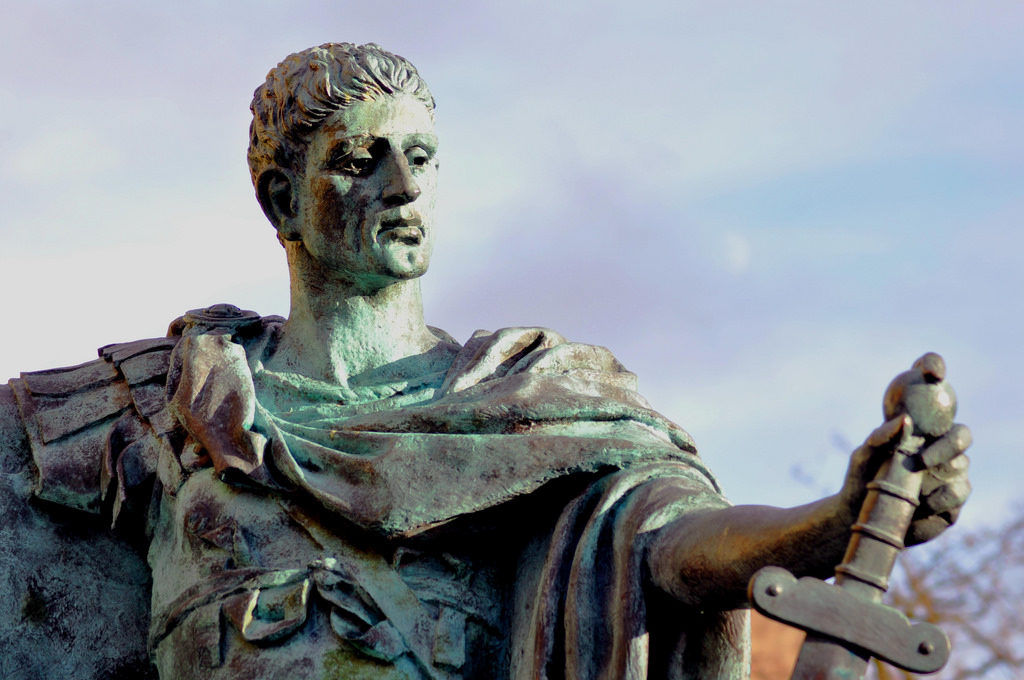
Constantine was one of the most influential of all the
emperors of Rome. His reign marked a definite turning point in the history of
the empire, which would never be the same again. He must also be counted as the
last truly “great” emperor of Rome. Although there were other notable emperors after his time, nobody was of anything like the same
quality.
That is not to say that Constantine was a perfect emperor –
far from it. He was an enigmatic character who is very difficult to assess. He
may have been the first emperor who became a Christian, but he did not always
behave in what most people would regard as a “Christian” way. Indeed, he was
capable of great cruelty at the same time as displaying tolerance and acting
wisely. His actions can also be seen as making the eventual fall of the western
empire inevitable.
His rise to power
Constantine was born in (probably) 275 in Naissus, which is
modern Nis in Serbia. His father was Constantius, who would become one of the
four co-emperors known as the Tetrarchs who divided the empire between them at
the behest, and under the control, of Emperor Diocletian. Constantius took on
this role in 305, having control over Gaul and Britannia.
When Constantius went to Britannia in 306 to sort out a
local uprising he took Constantine with him, which meant that when he died at
Eboracum (York) in July 306 the army was only too ready to proclaim Constantine
as his successor, although the job should have gone to the man who had been
nominated for this role by Diocletian (Flavius Valerius Severus).
Constantine’s reign lasted for nearly 31 years, but it took
18 years for him to become sole emperor. Those years were a period both of
sharing power and of eliminating his rivals.
They were also years of shifting loyalties, with the various
would-be emperors working out where their best moves lay. The two main players
at this stage were Maximian, who had been co-emperor with Diocletian and who
been forced to retire from power at the same time that Diocletian did, and his
son Maxentius.
Maxentius was able to get Constantine’s support for his own
claim to be a co-emperor by giving Constantine his sister Fausta in marriage,
despite her very young age – it would be nearly ten years before they started
living together as husband and wife.
However, Maximian, who had always resented his forced
retirement, tried to persuade Constantine to attack Maxentius, which Constantine
was not prepared to do. Instead, Maximian tried to usurp his son by ripping the
imperial robe off his shoulders. When Maxentius’s guard intervened, Maximian
had no choice but to back off, after which he sought sanctuary with Constantine
at Treveri (modern Trier on the border between Germany and Luxemburg).
This arrangement continued until 310 when Maximian tried to
seize power when Constantine was away on campaign. The attempt failed and
Maximian committed suicide.
Maxentius continued to be co-emperor in Rome, with control
over Italy, Spain and Africa, despite the fact that his position was unofficial
and another co-emperor, Licinius, was supposed to be doing that job.
In 312 Constantine took a big risk by deciding to challenge
Maxentius head-on. It was at this point that Constantine appears to have had some
sort of experience that convinced him to change his religious attitude. He was
clearly a deeply pious person, but his devotion had up to now been towards Sol
Invictus, the “Unconquered Sun”. This deity had its origins in Syria, and the
cult of Sol Invictus had first come to Rome courtesy of Emperor Elagabalus, who
had been the chief priest of the cult before unexpectedly becoming emperor.
Worship of Sol Invictus lapsed after the fall of Elagabalus but had been
re-introduced by Aurelian, who had made the cult one of the official Roman
religions.
What exactly happened to Constantine, and when, is far from
clear, mainly because later Christian writers were keen to see Constantine’s
“conversion” as a major event in the history of Christianity and to treat it as
something similar to St Paul’s vision on the road to Damascus. There are
various stories, including that Constantine was visited by Jesus Christ in a
dream and told to paint the “chi rho” symbol on his soldiers’ shields before
going into battle. Another is that Constantine looked into the sky and saw the
sign of the cross and the words “with this be victorious”.
A more likely explanation is that Constantine, seeking
support from Sol Invictus, saw a phenomenon known as a “solar halo”, caused by
sunlight being refracted by ice crystals in the upper atmosphere.
At all events, Constantine did not abandon his previous
beliefs on the spot and suddenly become a Christian. It may well be that he saw
Jesus Christ as Sol Invictus in another guise. When new coinage was issued
later in his reign it was Sol Invictus who was portrayed alongside the emperor,
and when a “day of rest” was instituted for the empire, it was “Sol Day” –
Sunday – that was chosen.
What we do know is that Constantine began his campaign
against Maxentius having placed his trust in the “Divine Mind”, although it is
far from clear what he meant by this. We also know that he conducted the campaign
with considerable skill and that he swept all before him after he entered
Italy. It was not long before he reached Rome and waited for Maxentius to face
him in battle.
The battle in question, fought at the Milvian Bridge across
the River Tiber, was decisive. Whether or not Constantine’s men fought with
Christian symbols on their shields, they were utterly victorious and Maxentius
was among those who were killed. Constantine could now enter Rome in triumph.
Constantine did not stay long in Rome and was soon on his
way back north. He was well aware that his next challenge was likely to come
from the fourth co-emperor, namely Maximinus, who had allied himself with
Maxentius. Constantine met his own ally, Licinius, to whom he gave his
half-sister Constantia in marriage. Licinius was clearly expected to deal with
Maximinus.
That is what happened. Maximinus had crossed the Dardanelles
with an army and met Licinius near Adrianople (west of modern Istanbul), where
he was soundly beaten. Licinius chased his retreating force back into Turkey
and caught up with them at Tarsus, where Maximinus committed suicide. The four
tetrarchs were now down to two.
The Roman Empire now effectively split into two halves –
east and west – with each comprising six of the 12 dioceses established by
Diocletian. The two emperors governed their realms with very little reference
to each other and neither – at first – showed much interest in challenging the
other for complete control.
However, problems arose when it came to planning for the
succession if and when either of them should die. In 315 and 316 both of them
became fathers of sons. Constantine already had a son, namely Crispus by his
first wife Minervina, but Constantine was not sure whether he wanted Crispus to
be his chosen heir. When Licinius’s son was born, the two men came to an
agreement that neither son should succeed, but that the heir for both halves of
the empire should be Bassanius, the husband of Constantine’s half-sister.
But then along came Constantine’s son by his second wife
Fausta, and he changed his mind. If anyone wanted evidence that Constantine’s
apparent conversion to Christianity did not include a change of heart in favour
of Christian morality, his machinations in favour of his family’s interests
should prove the point. Bassanius was promptly executed on a trumped-up charge
and Constantine prepared to make war on Licinius.
However, things did not go all his own way. Licinius proved
to be a tough nut to crack and Constantine could only conquer one of the three
Balkan dioceses held by Licinius. He was forced to accept a compromise over the
succession that recognized the claims of both infant sons as well as that of
Crispus. The treaty that settled this was signed in March 317 and stayed in
force for the next seven years.
By 324, Constantine and Fausta had produced two more sons
and a daughter. Seeing himself as heading a potentially powerful dynasty,
Constantine saw no reason why his family should share the imperial throne with
anyone else and decided to get rid of Licinius for good.
This was achieved without too much difficulty. The civil war
began in the summer of 324 and was all over by November. Licinius was sent into
exile but then suffered the same fate as the unfortunate Bassanius. There was
no doubt now as to who ran the Empire.
The first Christian emperor
With the Christians of the Empire now free from persecution,
they proceeded to do what religious fundamentalists have delighted in doing
down the ages, namely persecute each other. The relatively young religion was
riven with disputes over matters of theology, and Constantine was well aware
that this was a potent source of unrest. He decided to step in and knock some
heads together.
The dispute that caused most upset, and which was to have
the most profound implications, arose when a priest in Alexandria, named Arius,
had a sharp disagreement with his bishop, named Alexander. This was over the
nature of Christ and his relationship with God the Father. Arius maintained
that the two were “of different substance” and that the Son was subservient to
the Father. Alexander held that they were “of the same substance” and the Son (i.e.
Jesus) had existed for all time as opposed to being created when “born of the
Virgin Mary”.
Arius and Alexander each had many supporters for their point
of view, and the issue – in Constantine’s view – could only be settled by
bringing all the parties together and reaching a decision that would have the
imperial seal of approval. The grand council met at Nicaea, in what is now
Turkey.
The result was a statement of belief known as the Nicene
Creed, ostensibly composed by Constantine although probably drafted by
advisers, which (in amended form) has been the basic statement of belief held
by most Christian denominations ever since. It was a compromise between the two
opposing camps, although it supported Bishop Alexander’s view much more
strongly than that of Arius.
Given a free choice, many modern Christians might think that
Arius’s theory had much to recommend it – it does seem to make more sense
logically – but they are not given that choice. For this they have a semi-pagan
Roman emperor to thank whose grasp of theology was shaky at best and who may
well have decided that the view of a bishop held more sway than that of a mere
priest. Whatever the case, the decision stuck.
Constantinople
The other major reason why Constantine was the most
influential emperor of the later Roman Empire was his founding of a new capital
city for the eastern empire, which for many centuries bore the name
Constantinople.
Constantine was well aware that the future of the empire
depended on securing the eastern frontiers, in both Europe and Asia, and Rome
was too far from either to be where the emperor should be based. The ancient
city of Byzantium was an ideal location for an eastern base, being within
striking distance of several likely trouble spots, and this was therefore
Constantine’s choice.
Byzantium occupied a triangular peninsula on the north side
of the Bosphorus strait that connects the Black Sea to the Sea of Marmara.
Constantine’s new city could therefore be protected by the sea on two sides and
by a new wall on the landward side. It was not long before the new city outgrew
the original wall and new defences were built in the 5th century by
Emperor Theodosius II.
Another advantage of Byzantium was that seven hills could be
distinguished within its area, which meant that it could be seen as a symbolic
mirror of Rome, which was traditionally built on seven hills.
Constantine spared no expense in building his new capital,
which began with a splendid imperial palace and a hippodrome that could
accommodate 80,000 spectators. The city included churches, but older pagan
temples were retained. Public buildings such as baths and a senate house were
erected, although the senators of Rome were not expected to move to the new
city.
The speed of construction was impressive. Begun in 324, the new
city was consecrated in 330. This was partly due to elements of some of its
buildings, such as columns and tiles, being appropriated from buildings
elsewhere in the empire.
Running the Empire, and the succession
With Constantine concentrating his efforts on his new
eastern capital, how was the western half of the empire to be managed? At
first, his son Crispus was able to do the job, but disaster struck in the year
326. Various accounts exist of what actually happened, one of them involving a
love affair between Crispus and his stepmother Fausta, but, whatever the facts,
the net result was that Crispus was executed for treason and Fausta died soon
afterwards. She may have taken the side of her stepson in an argument with
Constantine and suffered the consequences.
Constantine was now left without an empress, so his elderly
mother Helena became his ambassador and undertook a grand tour of the east,
where Christian tradition asserts that she found portions of the “true cross”
in Jerusalem as well as building churches at sacred sites. She was later
honoured by the church as St Helena.
The empire, thanks largely to the reforms introduced by
Diocletian, was now organized on regional lines in a number of respects,
including the army. A strong leader like Constantine could keep all the pieces
working together, but what about the future? That was something that gave Constantine
much worry in his later years, as he realized that none of the potential
candidates for succession fitted the bill.
He had three surviving sons as well as two nephews whom he
saw as potential rulers of parts of the empire, but he did not consider
appointing a single “Caesar” who would step up to “Augustus” on his death. His
plan was evidently to divide the empire into five prefectures, with his nephew
Hannibalianus having control of Iraq once it was brought under Roman control.
It was while he was planning to invade Iraq in 337 that Constantine fell ill
and died.
Constantine’s final act was to have himself baptized as a
Christian, having spent his whole life as a dedicated follower of Sol Invictus
but with the sneaking suspicion that Jesus Christ and Sol Invictus were two
sides of the same coin. He also declared his intention to be buried as a Roman
emperor in the mausoleum that he had had built for that purpose in
Constantinople. His son Constantius later had the mausoleum consecrated as the
Church of the Twelve Apostles, which would probably have annoyed Constantine
greatly had he known.
By tolerating Christianity, and even taking an active role
in its development, but keeping at arm’s length from it on a personal basis,
Constantine made clear that being a Roman emperor and a Christian was perfectly
possible without going the whole hog as a “Christian emperor”. This was a
lesson that not all of his successors appreciated.
© John Welford